Showing posts with label textiles. Show all posts

Friday, 23 December 2016

the art of embroidered books

Book of Common Prayer & NT, 1625 & 1626. Sold by Christie's.:
Book of Common Prayer

Back cover of 17th century embroidered satin book with two sets of metal clasps. by Aria Nadii, via Flickr:
back cover of 17th Century embroidered satin book with metal clasps

N e e d l e p r i n t:

Embroidered satin book with floral motif. The Whole Booke of Psalmes (London, 1639):
Whole Booke of Psalmes, 1639, London

16th century embroidered velvet book with scroll and floral pattern. (by Aria Nadii):
embroidered velvet book, 16th Century

New Testament of our Lord Jesus Christ, London, 1609. Folger.:
New Testament of our Lord Jesus Christ, London, 1609

The Whole Booke of Psalmes: Collected into English Meeter (1625):
The Whole Book of Psalmes, collected into English Meeter, 1625

17th century embroidered satin book cover.    Embroidered satin book cover.  The Booke of Psalmes  (London, 1637)  Collection: The British Library:
17th Century embroidered Booke of Psalms, 1635

The Whole Book of Psalmes.  London: Company of Stationers, 1641. 16mo (74 x 41 mm).  Embroidered binding, both covers depicting an egret amid flowers and greenery, spine with four rosettes, a.e.g. Modern slipcase. Lacking final leaf (of Tables), headlines shaved, binding rubbed with some loss, rebacked with original spine laid down. #Fine Bindings  #Miniatures  #Embroidered:
Booke of Psalms, 1641, London

Embroidered Binding ~ Bible ~ English ~ 1645-1646 ~ University of Glasgow Library, Special Collections:
English Authorised Bible, 1645-46

Embroidered satin book ,1640 Collection : The British Library:
embroidered satin book, 1640

David & Goliath embroidered book cover. Book of Psalms from the British Library’s collection:
David and Goliath image from embroidered Book of Psalmes

Book cover | V&A Search the Collections:
Embroidered satin in silks, plaited with silk and silver threads,
seed pearls, metal, leather, lined with watered silk, 1652

Embroidered Binding - The Whole Book of Psalms (1636) University of Glasgow Library, Special Collections Sp Coll F-f.8 by University of Glasgow Library, via Flickr:
The Whole Book of Psalmes, 1636

Book cover, England, 1631 embroidery T.100-1964, V&A Museum:
Canvas covered with satin, embroidered with silver and silver-gilt threads,
spangles and coloured silk, 1631

the bible and the book of common prayer, ca. 1607, Metropolitan Museum of Art:
embroidered bible and book of prayer, 1607

Bible; King James Version, Embroidered Binding, Florals & Birds, 1628.:
Bible, King James version, 1628

ROLLER-PRINTED COTTON
tapestry bound devotional book with plaited bookmark, mid 17th Century

.:.
images found on pinterest

Monday, 17 October 2016

Textile with Boar's Head Roundels  Date: 7th century  Culture: Iran or…:
Textile with Boar's Head Roundels Date: 7th century

Woven silk 1100-1150 silk weft-faced compound twill from Al-Andalus, Spain.:
Woven silk lampas, Middle Eastern, 1100-1150

Textile fragment with interlace design 11th–12th centuries, Egypt Linen and silk Kelsey Museum of Archaeology, 91614:
Textile fragment with interlace design 11th–12th centuries, Egypt 

Fragment, 16th Cent Bursa. Metropolitan Museum of Art.:
textile fragment, 16th Cent Bursa

Monday, 26 September 2016

welcome to bedlam


This Sunday just gone I visited the latest Wellcome Collection exhibition with my friend - Bedlam. The exhibition explores the history of asylums in the UK, how the view of mental illness changed over the course of history, and the various cures and treatments employed to assist patients.

Asylum, installation by Eva Kotakova

Whilst the exhibition did roam around the concept of mental illness and asylums fairly broadly, it had a large section at the end celebrating art by people who have mental health difficulties - including a collaboration where a dream asylum was created, complete with a model, which included areas for patients to escape and also central market spaces where they were able to mingle together. The emphasis was on the choice of the individual, and I felt this was of key importance, that the individual themselves is central to their own recovery and able to make their own decisions regarding their healthcare where ever possible.

What also came to light was the strong link between perceived mental illness and creativity. Art from many patients was displayed and there were some fantastic drawings and paintings, alongside books and documents from early mental health pioneers (who employed astrology amongst other techniques) as well as photographs of asylum inhabitants, some of which were uncomfortably exploitative. What I felt from viewing the art created by these individuals was how fascinating and unique their view of the world is, many were also accomplished artists in their own right, some prolific.


"I danced frightening things. They were frightened of me and therefore thought that I wanted to kill them. I did not want to kill anyone. I loved everyone, but no one loved me, and therefore I became nervous"
from The Diary of Vaslav Nijinsky
.:.

It made me contemplate the difference between someone who is perceived as mentally ill and produces fantastic and skilled pieces, and an artist who does the same. What is the essential difference? Both see the world in a different way, with their own unique vision - yet rarely do we label famous artists as 'mentally ill'... much of this is due to the time in which they lived or were working - and the differing viewpoints of the time. I came away thinking of the importance of creativity for everyone, particularly as a cathartic activity, and of how important it is that we rethink mental illness and its perceived limitations.

I have included some of the work from the exhibition below, alongside other artists who I would have liked to see included in the exhibition.
'wolves sitting in a tree' by Sergei Pankejeff who was a patient of Freud

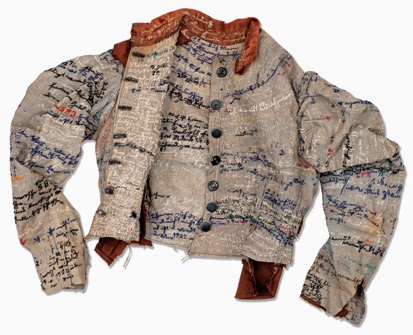
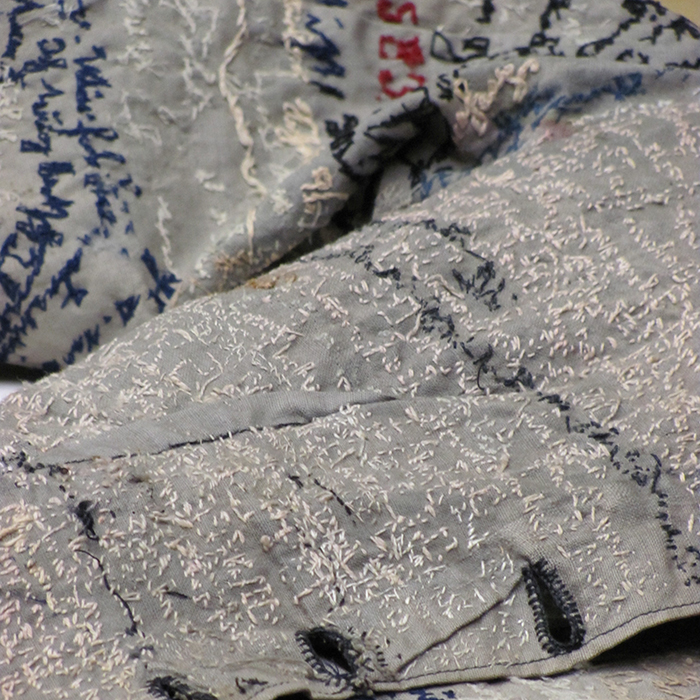
 The above garment was customised by Agnes Richter, who was a German seamstress held as a patient in an insane asylum during the 1890s. During her time there, she densely embroidered her straitjacket with words, undecipherable phrases and drawings which documented her thoughts and feelings throughout her time there.


drawings based on sketches by individuals who have schizoprenia
by Gert & Uwe Tobias


autobiographical lace by Adelaide Hall, completed whilst in an asylum

Syssigy 1957, by Leonora Carrington 
who suffered from a psychotic breakdown and was admitted to an asylum herself in Santander - later detailed in her novel 'Down Below'

Monday, 5 September 2016


linen, embroidered with blue and yellow silk; with stitching in flax, Egypt

from the online archives of the Ashmolean