Showing posts with label arthur rackham. Show all posts

Sunday, 19 February 2017

The Wild Hunt

Johann Wilhelm Cordes, The Wild Hunt, 1856/57 iamge via http://im-not-mine.tumblr.com/:
Johann Wilhelm Cordes, The Wild Hunt, 1856/7

__

'Twas hush'd: - One flash, of sombre glare,
With yellow tinged the forests brown;
Uprose the Wildgrave's bristling hair,
And horror chill'd each nerve and bone.

Cold pour'd the sweat in freezing rill;
A rising wind began to sing;
And louder, louder, louder still,
Brought storm and tempest on its wing.

Earth heard the call;- her entrails rend;
From yawning rifts, with many a yell,
Mix'd with sulphureous flames, ascend
The misbegotten dogs of hell.

What ghastly Huntsman next arose,
Well may I guess, but dare not tell;
His eye like midnight lightning glows,
His steed the swarthy hue of hell.

The Wildgrave flies o'er bush and thorn,
With many a shriek of helpless woe;
Behind him hound, and horse, and horn,
And, 'Hark away, and holla, ho!'

With wild despair's reverted eye,
Close, close behind, he marks the throng,
With bloody fangs and eager cry;
In frantic fear he scours along.-

Still, still shall last the dreadful chase,
Till time itself shall have an end;
By day, they scour earth's cavern'd space,
At midnight's witching hour, ascend.

from Sir Walter Scott's poem 'The Wild Huntsman'
____


Wotan on Sleipnir by Arthur Rackham

Friday, 16 December 2016

W I N T E R


Arthur Rackham, Winter Scene


Gustav Tenggren

Theodor Severin Kittelsen    ,,Nordic Thoughts:
Theodor Kittelsen, 'Nordic Thoughts'

 :
John Bauer, 'Frau Holle and Tomte'

Peter Christen Asbjørnsen, Norse Fairy Tales. Illustrations by Reginald L. Knowles and Horace J. Knowles. 'Hold tight to my shaggy coat', said the bear:
Reginald & Horace Knowles, illustration for Nordic Fairy Tales
by Peter Christen Asbjornsen

ivan biblin - Recherche Google:
Ivan Bilibin, illustration for Morozko


Kay Nielsen, illustration from East of the Moon and West of the Moon

Illustration by E.H. Shepard for A.A. Milne's classic and charming Winnie-the-Pooh stories. None of the sadly most well know obnoxiously animated Pooh absurdity here, or in the book.:
E.H. Shephard, illustration for Winne The Pooh


Arthur Rackham, Father Christmas


P.J. Lynch, illustration for A Christmas Carol


Edmund Dulac, illustration from The Snow Queen


Angela Barrett, illustration for The Snow Queen

Saturday, 29 October 2016

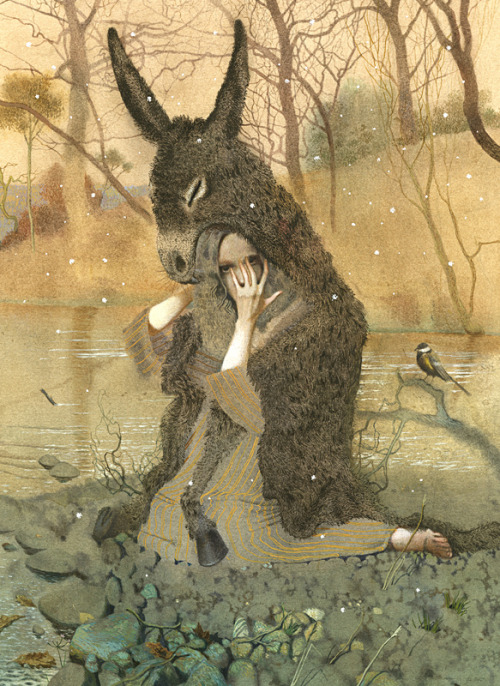
donkeyskin


two illustrations for "Donkey Skin” by Nadezhda Illarionova

illustration by Harry Clarke

.:.
Image result for donkeyskin

Image result for donkeyskin
Donkey Skin (dir. Jacques Demy, 1970)

.:.

illustration by John D. Batten

Arthur Rackham's illustration for Donkeyskin

Donkeyskin is an original fairytale, first published in 1695 by french author Charles Perrault. It belongs to the same genre of dark and adult themed tales such as Bluebeard, which deal with stark and harsh realities. It combines elements of fairytales that we are all familiar with - mistreated and downtrodden girl who suceeds against the odds, the concealment of beauty with grotesque transformation, the hybrid of the bestial and human - or exploration of the animal side of human nature, a handsome prince, a ring that will only fit the original wearer, fairy godmothers. It has all the familiar tropes, yet the subject matter - of incest and paternal abuse is in sharp contrast to more glittery interpretations of Cinderella for example, that we are acquainted with.

The King is married to a beautiful queen, who on her deathbed makes the King promise that if he re-marries it will be to a woman even more beatutiful than herself (as she does not believe this is possible), unfortunately, the only female who fits the role is the King's own daughter, and so he lusts after her, pressing her to become his wife. This unnatural yearning causes the girl to seek out her fairy godmother, who in an effort to stave off the King's vile attentions persuades the girl to request ever more elaborate dresses from him (believing he will find the task of sourcing them impossible). Sadly the dresses are procured, one a dress as bright as the sun, one a dress the colour of the moon, one a dress all the colours of the sky, and finally, the hide of his marvelous donkey (which crapped gold, and thus was the source of his kingdom's wealth - his kingdom was literally built on donkey shit!). The only option left to the poor girl is to escape, in the guise of the final costume - the donkeyskin.

"Saint Dympna, a seventh century princess and now the patron saint of the insane, was also wanted in marriage by her father, a king of Brittany, Britain or Ireland. When she refused and ran away, having already committed herself to her Christian faith, he found and beheaded her. She even has a "godmother" figure in her elderly confessor who dies with her"
Marina Warner, The Beast and the Blonde, 1994 (quote found here)

The choice of the donkey is important I think. It is often regarded as a lowly farmyard animal, certainly less regal in aspect than the horse. Yet it is famed in literature from early times. Apulieus wrote 'The Golden Ass', and Aesop also included a donkey in his fables. The donkey also of course was the vehicle of choice for the Virgin Mary in the traditional biblical story.

Robed in this hideous apparel she escapes, and assumes the disguise of a servant, eventually a prince spys her trying on her beautiful dresses through a keyhole and marries her. I can't help but see this as eventual escape through degradation, adopting the guise of an lowly animal. Through concealment and transformation of form she is liberated, by transcending her human form she is able to eventually find 'happiness' and a relationship away from the abuse of her father,

"One day she was sitting on the banks of a stream bewailing her wretched lot, when she suddenly caught sight of herself in the water. Her hair and part of her face was quite concealed by the ass’s head, which was drawn right over like a hood, and the filthy matted skin covered her whole body. It was the first time she had seen herself as other people saw her, and she was filled with shame at the spectacle. Then she threw off her disguise and jumped into the water, plunging in again and again, till she shone like ivory. When it was time to go back to the farm, she was forced to put on the skin which disguised her, and now seemed more dirty than ever; but, as she did so, she comforted herself with the thought that to-morrow was a holiday, and that she would be able for a few hours to forget that she was a farm girl, and be a princess once more"
Charles Perrault, Donkeyskin

What is genuinely alarming and disconcerting here is the male gaze - the central character of Donkeyskin is unable to escape, first her own lecherous father lusts after her, and then she is observed through a keyhole whilst dressing (unwanted attentions from the Prince). It is clear that she has no future without the involvement of the male - she must submit to male domination. Her sole merits in the eyes of the court are her beauty (once she disrobes from her bestial cloak) and her skills at cooking (she bakes the lovesick prince a cake) but she does not appear to be valued for herself, she is viewed as currency.

There have been numerous contemporary explorations of this particular name, notably the Jacques Demy film of the same name, where Catherine Deneuve plays the role of Donkeyskin.

Saturday, 15 October 2016

the woman who knew magic

‘The Woman Who Knew Magic’ by Arthur Rackham. Watercolor on paper.  Unused illustration for Hans Christian Andersen’s story,  The Snow Queen, in ‘Fairy Tales’, published 1932 by Harrap, London.:

The Woman Who Knew Magic by Arthur Rackham
Watercolor on paper.
Unused illustration for Hans Christian Andersen’s The Snow Queen, in ‘Fairy Tales’, published 1932 by Harrap, London

Wednesday, 5 October 2016

the tale of jorinda and joringel

The Witch in the guise of an owl by Arthur Rackham

Katherine Langrish drew my attention to this particular Brothers Grimm tale, which is laden with heavy symbolism, from the owl, the transformation of the female form - to the flower wet with dew, the entrapment and capture within the bird cage and the subsequent unlocking and release. If you get the chance I thoroughly recommend getting your hands on a copy of her Seven Miles of Steel Thistles book, which has a detailed analysis of this tale.

The witch from Jorinda and Joringel, an illustration by Mervyn Peake for Household Tales.:
illustration by Mervyn Peake

.:.

The owl is an ancient symbol of the goddess Athena, and was and still is seen as a portent or omen - in the Roman world (the equivalent deity being Minerva) an owl hooting on top of a building was seen as a harbinger of death. The owl is nocturnal, therefore can see in the dark, giving it the quality of wisdom. Along with creatures such as the toad (see my previous post on toadlore) the owl is frequently linked to witchcraft. Here the character of the witch can metamorphose into an owl - women frequently possess shapechanging abilities, especially into the form of a bird in mythology - we see this repeatedly in Ovid's collection of tales Metamorphoses. It is interesting that both female characters in this tale morph into birds - one willingly and one forcibly.

 :
illustration by Chris Beatrice


The tale seemingly explores notions of coercion and consent. Langrish likened the Witch as being like a modern day marriage counsellor, as she imprisons Jorinda, making Jorindel prove his worthiness and seriousness of his intentions, only then is she rescued and they are reunited in marriage. It is almost as if the witch is forcing Jorindel to prove his worth, keeping the girls imprisoned in bird form to protect them. One could be tempted to run away with this entirely interpreting the Witch through a strongly feminist slant, creating her own community of females devoid of the male gaze, and therefore reclaiming female space. The Witch is a character who has complete autonomy... but I will refrain.


Jorinda and Joringel. From “Anne Anderson's Fairy Tales and Pictures” (1935):

illustration by Anne Anderson


The symbol of the flower is laden with obvious sexual connotations, and reminds me of a similar symbolic use in one of my absolute favourite films Valerie and her week of Wonders, where daisies are coated with drops of blood, symbolising sexual maturity and the onset of menstruation. Here the flower possesses the power to 'unlock' the birdcages, and free the entrapped girls within.


still from Jaromil Jires, Valerie and her Week of Wonders, 1970

.:.

illustration by Arthur Rackham